Showing posts with label 1%. Show all posts

Sunday, 24 February 2013

Fix the Debt: bipartisans fooling some of the people all of the time (a primer on the solidarity of the 1%)

Gaius Publius is upset with bipartisan support for Fix the Debt, and points out the class-based solidarity of the rich (which of course aligns interests both within and beyond the nation state in ways that appear unprecedented to us today, but remind us of how things were during the last gilded age). He says:
Most left-side commenters paint "Fix the Debt" — the well-funded campaign to scare Americans into believing the debt is not only going to destroy us all, but that massive cuts to Medicare, Social Security and Medicaid are the only way to "fix" the "problem" — as a billionaire-led, CEO-led operation to kill (or at least seriously maim) the social programs by delivering one blow after another. But Fix the Debt is also a bipartisan operation.
This is about bipartisanship — real bipartisanship, bipartisanship in the bad way. 
...The real divide in this country is not Left versus Right — it's the Rich versus the Rest. It's the horizontal division between the people taking all the money they can, and those they're taking it from.
Among the rich, there's a widely-agreed center position — more for us, less for everyone else on the planet.
GP directs us to research done by watchdog group SourceWatch: a Fix the Debt portal, where they say:
The Campaign to Fix the Debt is the latest incarnation of a decades-long effort by former Nixon man turned Wall Street billionaire Pete Peterson to slash earned benefit programs such as Social Security and Medicare under the guise of fixing the nation's "debt problem." Through this special report -- and in partnership with The Nation magazine -- the Center for Media and Democracy exposes the funding, the leaders, the partner groups, and phony state "chapters" of this $60 million "astroturf supergroup," whose goal is to achieve a grand bargain on austerity by July 4, 2013.
SourceWatch lays out the various supporters and their bipartisan credentials, corporate ties and conflicts of interest; most have transitioned at least once from politician to lobbyist and/or vice versa, and big pharma, big oil, big finance, and the health insurance industry are all well-represented.  This is a delightful romp through the revolving door of democracy, American style.

GP says many (or most) of these individuals also have big-time conflicts of interest, as documented by Source Watch; they stand to benefit personally if what is now public becomes private and for-profit. They are all simple rent seekers, in other words, and the national debt is their trojan horse (or is it a rabbit).  This is not (or should not be) news, yet time and time again we see that you can fool some of the people all of the time...and, per George W. Bush,  "those are the ones you want to concentrate on.”

For an absolutely terrifying view of what that kind of concentrating looks like, GP ends with this video (which I can't even get all the way through so I can't tell you how it ends). The sheer number of rhetorical games played in the first 15 seconds alone is enough for me; when they get to the dancing I just want to weep.


Wednesday, 13 February 2013

US and Canada do some more dancing on energy

From the FT: US approves $18bn Cnooc bid for Nexen. That headline struck me as odd--why would one non-US company acquiring another non-US company require US approval? But this is the oil & gas industry, and that impacts US security, so bring on a committee review:
Tuesday’s approval from the Committee on Foreign Investment in the US, a multi-agency body that reviews large deals that could affect US security, gives Nexen “all of the requisite approvals to proceed to close”...

Late last year it looked as if Cfius might challenge the deal. In November, Cnooc and Nexen resubmitted their agreement for approval, raising concerns that Cfius was taking a hard line.
Though less than a tenth of Nexen’s assets are in the US, those that are include a series of oil platforms in the Gulf of Mexico. Some of those are near US military assets, leading some to believe that Cfius might block the deal or require mitigation agreements.
The US (or at least two American brothers) has pretty high financial stakes in the Canadian oil & gas industry, as a recent real news interview of BBC's Greg Palast reveals: if the Koch brothers (yes, those down-home folks with their "plan to reshape America")  can get that pipeline through, they can cut out their Venezuelan competition with a cheap alternative, putting an additional $2B or so in their pockets each year. But this time the US interest is not about its energy security, at least according to Palast. Rather, the plan here is to sell the supply on to the Caribbean. From the transcript:
[The Koch brothers says to themselves] If we can use our political muscle to jam a pipeline through the guts of the United States down to Texas...we can make a killing. 
And by the way, they're making an extra killing. When the Republicans were talking about the XL Keystone pipeline making us energy-independent...We're not energy-independent if it comes from Canada. But if it comes from Canada, let's assume that this is our buddies, because they'll give us the oil cheap, and that's what makes them our buddies. 
It also undermines Hugo Chávez. They have to undermine Chávez, which they want to do for geopolitical reasons. 
But then the oil will not be used in the United States. It will be refined mostly for gasoline that will be sold at a premium in the Caribbean. Remember, these refineries are in the Gulf coast. Selling it, then running that stuff back into New Jersey is not a moneymaker. The way you make the money is you sell gasoline in places that don't have the refining capacity and will pay a premium, like, you know, Jamaica, Santa Domingo. That's where your money's going to be made. So this is oil from Canada which will then go into the Koch refineries and sold into the Caribbean.
I admit I am puzzled. How is it in the interest of either Canada or the US to build a mechanism for the Koch brothers to insert themselves as intermediaries in an energy supply chain to the Caribbean? From Canada's perspective, why not cut out the middleman, or to out it another way, why be such good buddies?  Is this a question of risk, cost, technological capacity, logistics, something else? And for the US, if the environmental hazards to communities across the nation are as Palast describes, why subsidize that risk for the greater personal profit of billionaires when the political costs of support for the pipeline seem so high? 

I also don't know the financing of the pipeline, haven't studied it. I am scared to go and look, if I am going to find out that the entire infrastructure is to be underwritten by government.

Monday, 11 February 2013

Protesters Confront "Fix the Debt" Leader over Corporate Tax Breaks

And they do it with a big sign:


The protestors are calling themselves "Flip the Debt."  From truth-out:

While speaking at a Fix the Debt conference on Monday, Honeywell International Inc. CEO David Cote [he of "union busting for dummies" fame] was interrupted several times by Flip the Debt protesters over tax loopholes that allow companies like Honeywell and General Electric to pay far less taxes than ordinary Americans. 
Three minutes into Cote's keynote address, the first heckler trumpeted: 
...Fix the Debt is nothing more than a CEO lobby whose real objective is huge corporate tax breaks and drastic cuts in Social Security, Medicare and Medicaid. David Cote and his CEO friends receive a lot from government: In 2011, Honeywell received $725 million in government deals, making it the 35th largest federal contractor. However, Honeywell and other companies pay next to nothing in taxes. Honeywell's tax rate from 2008-2011 was 2 percent. Does anyone in this room pay 2 percent?"
 The crowd applauded, but Cote only laughed nervously.
So, he neither confirmed nor denied whether he paid 2%.  An interesting nod to the UK, similar to the spread of the "Uncut" movement across the atlantic:
Gan Golan, cofounder of Flip the Debt, laid out his group's goals. "We will disrupt Fix the Debt meetings across the country to elevate our message that the biggest corporations in the country aren't paying taxes, and now they want the rest of us to pay for it. Sustained public pressure against corporate tax dodgers in the UK has put the issue at the top of the agenda there, and we hope to do the same."
The article mentions the Sanders bill to end deferral, and ends on the connection between tax dodging by multinationals and the dismantling of the welfare state:
Charlie Balban, president of the Alliance for Retired Americans-New Hampshire, grilled Cote during a question-and-answer period. "We should do something about the debt, but we don't need to cut programs that people depend on. Instead of reducing the deficit on the backs of working Americans, corporations should pay taxes like the rest of us."
It can't be too much longer before someone draws up a menu of welfare state expenditures in the US and then ties each item to a specific company and what they might have paid in taxes had they incurred the statutory rate on their income for the year.  If you see such a thing, please send me a link.

Monday, 4 February 2013

Galt's Gulch Chile, Randian Utopia?

I've called charter cities "the ultimate gated community," and it turns out that characterization wroks well as a marketing strategy designed to appeal to Randians with visions of state-free utopias dancing in their heads:
With the oppression of the over regulated, over taxed, war riddled and welfare riddled society consuming the world, Ayn Rand's famous protagonist character, John Galt, came to conclude that he would not use his talents to support such a society any longer...driving him to create a community where scientists, inventors, entrepreneurs and many others would come together to escape from the confines of their daily lives to not only be free...but to thrive.  
In today's world, it is becoming more and more difficult to find true freedom from very much the same oppressive forces Ayn Rand wrote of...which drove John Galt and others to a place where they found their freedom, success and peace of mind. 
But you can find yourself in just such a utopia for a modest investment:
Residential lots at Galt's Gulch Chile will be offered at much more affordable price points than one would expect for a community of this caliber. In the initial phase of the project, which is over 4,200 acres, lot sizes will range from 1.25 acres up to over 10 acres, within the separate neighborhoods of the master planned community, which is projected to have well over 1,000 lots on over 10,000 acres at build out. 
I have no idea what price point to expect from a community of that caliber.  Doesn't it depend on the height of the retaining wall built to keep the bands of roaming marauders out of my libertarian paradise?

Pictured: libertarian paradise
See that? No walls.  Also: no pesky roads, schools, hospitals, police stations, firehouses, courts, legislative bodies, telecommunications equipment, etc. But wait, here's another image:

These walls appear inadequate to protect paradise.
Galt's Gulch does have a facebook page...good thing facebook is still "free"!  But ...what is this?
The lots, roads, lakes and community amenities of Galt's Gulch Chile are currently being laid out by the architecture and engineering team. The on-site sales office is being retrofitted with solar panels and upgraded a bit inside and out, with a proposed opening sometime in March. Our Santiago office should be open sometime in the next two weeks as well. We look forward to getting in contact with everyone and meeting you down in Chile!
and, from their website:
Galt's Gulch Chile is slated to have all of the world-class amenities ...including a championship-caliber golf course, community clubhouses, tennis facilities, spa and fitness centers, hiking trails, horse facilities and trails, vineyards, underground storage facilities, downtown main street shopping, farmer's market, 24-hour guard-gated security and many others.  
Since there will be no imposing of onerous regulations or taxes here in Galt's Gulch, these items will obviously have to be priced into those "much more affordable price points than one would expect for a community of this caliber." But at least you won't have to use your talents to support a society. Your benevolent dictator GALT'S GULCH TRUSTEE LIMITED in Menlo Park, CA will contract you right out of all that messiness. Right? ....or, perhaps not.

Will this be like Independence, USA, "an entire city, developed around patterns?"


Actually, it does sound a little alike:

Galt's Gulch Chile is being designed to be a fully self-sustaining community, affording those who live there an abundant and unending supply of fresh drinking water from the natural springs located throughout the mountains and valleys of the community, clean and renewable energy from hydroelectric and solar power generation, organic fish from the scenic manmade lakes...and a plethora of organic fruits, vegetables and nuts, born from the fertile soil and the ideal year round climate of the region. 

Well then! Oh, how I yearn to sign up for more information on Galt's Gulch, if only it wouldn't mean being inundated with advertising from some trustee company in California trying to prey on my basic mistrust of government.


Monday, 28 January 2013

Human rights and tax secrets

Think those two don't go together? Prince Charles begs to differ:

Prince Charles has used the Human Rights Act and the Official Secrets Act to block revelations about his tax affairs – even though Her Majesty’s Revenue and Customs has said the disclosure would be in the public interest. 
The move follows a bid to uncover the secret arrangements which allow the Prince of Wales to avoid paying tax on the Duchy of Cornwall, his vast estates which generated £18 million profit last year. 
The test case centres on a request by an academic who has asked to see correspondence between the Duchy of Cornwall and HMRC. 
But the Government and the Duchy of Cornwall have refused to agree to the release of the documents because the disclosure would breach Charles’s right to privacy. They also say the information is protected by the Official Secrets Act. 
John Kirkhope, an expert on trusts law from Weston-super-Mare, Somerset, is trying to use the Freedom of Information Act to uncover how HMRC came to grant the Duchy a tax exemption which is estimated to have been worth millions of pounds over the past century.
The issue here is the right of the public to know what the treasury already knows.  A spokesman for Prince Charles said "The Duchy is not a company and is not therefore liable to pay corporation tax." That is completely irrelevant. What is being asked here is not whether tax has been levied and if not why not, but whether the public has a right to know whether tax is being levied, and if not, why not.  That is a transparency question, the kind that animates EITI& CBCR. Of course, neither of these regimes would extend to the Duchy, since its not a public corporation.

Relatedly, notice that the Prince's right to privacy is the invoked protection against the government's disclosure of his tax information to a third party, i.e., a party other than the government itself. That right is, of course, what any UK taxpayer that also has US status will have to forego in order to fulfill the UK's FATCA obligations. No official secrets act protection in that case--just the data privacy act, which the UK has said only requires UK financial institutions to inform (not obtain consent from) their customers whose information they will disclose to the US.

Thursday, 24 January 2013

Billionaires of the world ranked and charted

From Flowing data, links and commentary on an interactive chart called "Bloomberg's Billionaires", where you can see who the world's billionaires are and how they compare to each other:
Billionaires ranked

There are four main views. The one above shows rankings, their estimated net worth, and the change from the previous estimate. Below is a simple ranking of the world's billionaires. Each floating head is clickable so that you can more information about the individuals, such as a short bio and where there money is from.
Billionaire floating heads
It gets more interesting when you click around and explore. For example, there's a plotting view, and the floating heads transition to their sectors, still sorted by ranking:
Richest people in the world
...[You can] Filter by gender, industry, citizenship, age, and whether or not a billionaire's money was mostly inherited. The slider on the bottom allows you to go back in time to see rankings and net worth change. That part did seem buggy though, as heads seem to disappear or get stuck if you shift too much.
Fascinating, if voyeuristic, and in the typical vein of media obsession with the rich. If Bloomberg produced "Bloomburg's Penniless," and told us all about some of the world's poorest people and just exactly how they got there, would we pay attention?


Thursday, 10 January 2013

Avoid Paying Taxes The Warren Buffett Way

The Buffet rule, read it and weep edition:
[One] reason why we hold Berkshire is because of Buffett's uncanny ability to mitigate Berkshire's tax expenses, particularly Berkshire's cash tax payments. We are aware that this is not to be talked about in polite company especially because Buffett has been pounding the table for higher statutory tax rates. … 
We think that Warren Buffett said it best when he said if you can eliminate the government as a (39.6%-46%) business partner, the business will be far more valuable.
How about just eliminating government all together?  How will Berkshire do in the state of nature, do we think. Would roaming marauder business partners cost less?

Monday, 7 January 2013

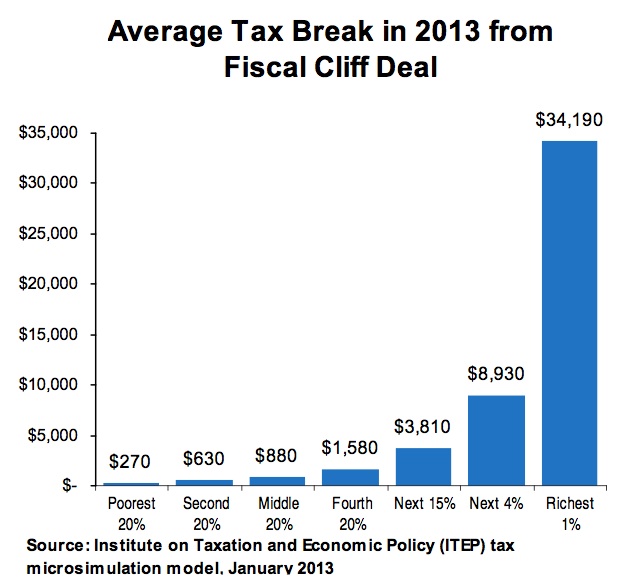
Lobbying pays: the skewed impact of the fiscal cliff deal, in one striking chart

From Citizens for Tax Justice:
In 2013, the richest one percent of Americans will receive 18 percent of the tax cuts while ...[t]he bottom three-fifths ... will receive 18 percent of the tax cuts. In other words, the richest one percent of Americans will receive the same share of the tax cuts as the poorest 60 percent of Americans:


Note that it is hard to give tax breaks to the poorest, since they aren't much in the tax net to begin with. But what explains the middle? CTJ notes that the deal made permanent 85% of the Bush income tax cuts and 95% of the estate tax cuts, which we already know were skewed toward the wealthy and have presided over the largest widening of the income gap in US history since the gilded age. That is destroying the middle--there aren't so many people in that category any more.  And the ones still in the category have much less to work with:

Why did the fiscal cliff turn into welfare for the 1%? We know the answer, it's always the same. Incidentally Matt Stoller wrote a follow up piece arguing that if we understand how lobbying corrupts policymaking in the US, we can work against it.  But I am not optimistic.

Lobbying is policy in the US. That is how governance works. There are good aspects and bad aspects to the ability of the public to influence lawmakers in a democracy; the issue is what happens to democracy when you have to pay enormous sums to play. It seems that one thing that happens for sure is that elected officials become "utterly unresponsive to the policy preferences of millions of low-income citizens.” Major social imbalance is the result when, as Nancy Folbre says:
Our most affluent citizens now have less to gain from cooperation with the rest of us than they once had. They can effectively threaten to opt out and invest elsewhere. They can also invest vast resources in lobbying and electioneering.
I am still puzzled as to how on earth the NY Times managed to get their headline so wrong. Yves Smith calls it a big lie, and I would have to concur.

AIG PR Blitz “Thanks” Taxpayers For Bailouts

Something went horribly wrong in AIG's public relations department:
what is the message here from AIG?
“I needed money so I stole your car, robbed a liquor store, and now I am giving you your car back and I left a portion of the liquor store loot…”
And I'm proud of that. Thank you, America!

The PR dept didn't completely fail though: they were smart enough to disable the comments section:


Monday, 17 December 2012

Fortune 500 holding trillions offshore

Taxprof links to a Citizens for Tax Justice report (pdf) that says Fortune 500 corporations are holding at least $1.6 trillion in profits offshore.  290 of the 500 collectively self-reported the figure (via SEC filings), as at the end of 2011. Interesting: half of the $1.6T is reported by just 20 companies (7% of the self reporting, .4% of the fortune 500--the corporate 1%?).  The report includes a list of each of the 290 and the amount they reported as offshore.

It looks like notorious tax dodger GE tops the list here, with $102B waiting for a holiday to repatriate (recall that GE's global head of tax Will Morris, is also head of the tax committee of the business and industry advisory council at the OECD, winner of an "external engagement award" for his service to HMRC, and a long time and vociferous opponent of corporate tax transparency efforts through the OECD and related fora, for a discussion, see here).

Next in line comes a familiar cast of characters, all on that ever-growing tax dodger ledger:


But really, every big American company you can think of appears on this list.  Starbucks can be forgiven for being a bit touchy on the tax dodging radar, since its offshore holdings of less than a billion look positively benign compared to the companies occupying the top of the list.  No wonder that multinationals fear increased corporate tax disclosure, because you never know where the media will train its spotlight for naming and shaming.

Friday, 5 October 2012

Evidence: it's ok to tax millionaires

Richard Murphy points to this story that argues, contrary to conventional wisdom, millionaires do not necessarily flee high tax jurisdictions in search of tax havens:

From the article:

This newspaper's review of tax return data for 2010, the most recent year for which data is available, found no link between the state income tax rate and the number of people who reported adjusted gross income of at least $1 million.
Consider:
  • The states with the most and fewest rich people per capita are Connecticut and West Virginia, respectively. In Connecticut, one of 190 taxpayers earns at least $1 million in adjusted gross income. In West Virginia, just one out of every 1,400 filers make that much. Yet both states tax rich people about the same.
  • Our neighbors: Nevada is income-tax free; Oregon has one of the nation's highest income taxes on the rich; and Arizona is about average. Yet all three have a below-average number of rich people per capita.
  • In the Midwest: Illinois and Ohio charge about the same income-tax rates and have similar populations. Yet Illinois has 233 millionaires per 100,000 taxpayers, while Ohio has 107 per 100,000 taxpayers.
  • In the Northeast: Massachusetts has more than double the millionaires per capita than neighboring New Hampshire, which is income-tax free.

Murphy concludes from this report that "It's fairly easy to move in the US. But people don't."  He therefore suggests we lay the mobility myth to rest since it would be comparatively much more difficult to move across national borders.  If people don't do it when it's easy, what will make them do it when it's hard?

I think and hope this is generally true--that people have cultural/social ties to places that prevent purely fiscal decision-making, so we don't need to coddle the rich out of fear of a Randian exodus, but can ask them to contribute more to the societies in which they live.  But the high profile cases we see in the news suggest that when it comes to the super-rich things might not be so clear.  Maybe they stay put but nothing stops them from engaging in the standard game playing that puts money out of sight to governments while doing so.  It could even be worse for society if they physically hang around but play all kinds of games rather than paying their taxes; in that case, it might be preferable if they pull a Saverin.


Saturday, 28 April 2012

Stateless and Superrich

FT has an article today that is worth reading for how it considers the local social and cultural impact of the income gap at the extreme: mega mansions arising in neighborhoods that end up empty much of the time as their owners jaunt from property to property throughout the year, and the attendant service industry that grows to meet the expectations of the sojourner class.

I mostly ignore the House & Home section of the FT, along with How to Spend It, because neither applies to me and in fact they often irk me--I'm trying to read the news here, and your annoying content about lavish lifestyles are not only not news, but they are a sign that I am not your intended demographic; pardon my intrusion.  Ironically, that is the central message of this story.  The quote from Saska Sassen is telling:
“Even very good architects manage to generate a style that is not usually much admired by engaged residents and passers-by, whether the poor aficionado urban historian, old wealth, or anti-gentrification activists."
I had to read that twice.  But I think what Sassen is saying is that the housing and amenities that appeal to the 1% are to society and culture what the house & home/how to spend it are to news consumption for me: commanding of attention, and even driving the whole design, yet completely irrelevant and even bothersome when put into the context of a social fabric that is mostly not about them.


Friday, 20 April 2012

Trickle down not working in UK or anywhere else

Renegade Economist tweets and answers: "Do income tax cuts for the rich make us all richer?  See dismal evidence showing this is not true," with a link to this:


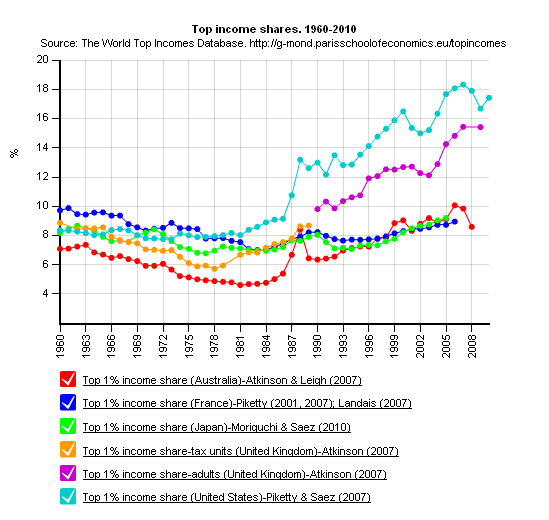
and this, showing UK's top 1% through the ages & with projections backward and forward:


and here is the UK's top 1% compared to a few other places:
The author concludes: "The argument that giving the moneyed elite more money will make everyone wealthier manages to ignore the roaring evidence of the past."


Tuesday, 13 March 2012

The 1%: indifferent about their tax rate

Bruce Bartlett: Would a Higher Top Tax Rate Raise Revenues?

On Friday, Prof. Allan Meltzer of Carnegie Mellon University, a well-known conservative economist, offered a commentary in The Wall Street Journal arguing against policies to equalize the distribution of income.  [Meltzer used the Piketty Saez study, linked earlier here] to say that 'domestic policy can’t be the principal reason for the current spread between high earners and others.'
... If, as Professor Meltzer has shown, the rich get richer regardless of the tax rates, there is no economic reason not to raise the top rate. Perhaps unwittingly, his research confirms that of other economists who say that we could get substantial additional revenues even if the top rate doubled.