Friday, 12 October 2012

Tax decisions by Canada's newest SC Justice

Richard Wagner, a Montreal native and a graduate of uOttawa Law, was sworn in today as Canada's newest Supreme Court Justice,* and I asked one of my student to find me his tax decisions.  It's a very short list, of just eight cases (out of a total of 508 decisions (150 rendered at the Superior Court of Quebec and 508 at the Court of Appeal, though the latter were signed, not always authored, by the Justice):
Productions Merveilles inc c Montréal (Ville), 2006 QCCS 213
Municipal Taxation; Real estate transfer tax
 A common-law couple (Productions Merveilles), both lawyers, tried to avoid a transfer tax that is usually incurred when selling immovable property (i.e., real estate). Each party owned a company with an independent active business. Property was transferred between the two companies. The couple argued that due to their personal relationship, identical corporate infrastructure (e.g., same business address), and shared benefit, they share the same patrimony and therefore these transactions should meet the standard of “closely linked entities” (defined as having control of at least 90% of shares) and be exempt from the transfer tax.  Judge Wagner rejected the shared patrimony argument and found they had a joint venture, decision in favor of the City of Montreal. 
Peintres Filmar inc c Lapointe, 2007 QCCS 1491
CRA search and seizure
Filmar claimed false business expenses to evade taxes. The CRA proposed amnesty if the fraudulent invoices were surrendered. Filamr complied, but only partially. After realizing that disclosure was only partial, the CRA further extended its amnesty in an effort to gain Flimar’s full cooperation. When Filmar refused to comply, the CRA obtained a search warrant and seized documents.  Filmar claimed his Charter rights were abused (section 7: “right to life, liberty and security”; section 8: “unreasonable search and seizure”; and, section 24(2): “exclusion of evidence that would bring the administration of justice into disrepute”).  Justice Wagner disagreed: the seizure was valid, the CRA’s actions were in compliance of the applicable laws, Filmar’s non-compliance invalidated any limitations on seizures, and furthermore the CRA was reasonable, and even generous, in its dealings with Filmar. 
Bromont (Ville) c Québec (Cour du Québec), 2011 QCCA 482
Rejection for leave to appeal
IBM sought to exclude certain assets from its municipal base (tax expenditures for industrial use of a facility). The city of Bromont disputed IBM’s assessment. The Quebec Administrative Tribunal ruled in Bromont’s favour. The Court of Quebec reversed. The Superior Court found that part, but not all of IBM’s exclusions should be allowed.  Appeal denied: the Superior court’s decision was reasonable; there is neither an issue of interest, nor one that creates controversy. 
Re Garippo, 2011 QCCA 1143 (with Justices Hilton and Morissette)
Rejection, without reasons, for leave to appeal 
Construction Louisbourg ltée c Québec (Juge de la Cour du Québec), 2011 QCCA 1636 (with Justices Doyon and Dufresne)
Affirmation of Superior Court’s decision to allow the search and seizure of commercial documents in a criminal tax investigation, citing public interest as the reason for upholding the lower court’s judgement.
Banque Nationale du Canada c Agence du revenu du Québec, 2011 QCCA 1943 (reasons by Justice Dalphond; signed by Justices Wagner and Bouchard)
Banque Nationale managed a bankrupt company’s assets, during which money allocated for taxes was not paid.  Held: Banque has a fiduciary relationship, through a constructive trust, with Revenue Quebec and must pay part of the unpaid amount. 
Cantley (Municipalité) c Jinlili International Trading Ltd, 2012 QCCA 1151 (with Justices Hilton and Kasirer)
Short joint decision concerning how fees wrongly incurred by the municipality should be refunded. 
Pellan c Québec (Sous-ministre du Revenu), 2012 QCCA 1632 (reasons by Justice Biche; signed by Justices Wagner and Bouchard)
Jurisdictional matters
A group of soldiers filed a class action, claiming that they were wrongly assessed by Revenue Quebec for income earned while serving overseas.  The Superior Court declined jurisdiction and said the action should have gone through the Court of Quebec (provincial court).  Appeal Allowed: the Superior Court was a valid vehicle for the claim.
Nothing too earth-shattering here, though the government or agency prevailed in most cases.  It's a very small sampling size, so I am not sure we can read too much into that.  Interestingly enough, among his many accomplishments, Justice Wagner was President of the Quebec Bar's Construction Law Section.  We've got lots of problems with the construction industry here in Quebec.  Too bad we haven't had an Al Capone moment.  Maybe we still will.

* I note a bit of an oddity here with respect to the swearing in.  I've got a SCC press release in my inbox that says the following:  "OTTAWA, October 12, 2012 – The Honourable Mr. Justice Richard Wagner was sworn-in as a judge of the Supreme Court of Canada before The Right Honourable Beverley McLachlin, Chief Justice of Canada, and the judges of the Court in a private ceremony on October 11, 2012. A formal welcome ceremony will take place on a date to be announced."  Nowhere on the web can I find any information at all about this swearing in ceremony or the formal ceremony to come, indeed I cannot even find the press release itself on the SCC website or on the Canada News Centre press release site, where they ostensibly post all government press releases as they emerge.  So now I am curious, why is there a private swearing in, and a "formal welcome ceremony"?  And is it really not news that a new SCC Justice has just been sworn in?  Canadian court & media watchers, please advise of this custom.


Thursday, 11 October 2012

RIP Prince Roy, Sealand's Head of State

This is a special shout out to tax policy at UW, fall 2011-slash-international tax spring 2012, you know who you are.  I am sorry to inform you that one of our favorite personalities has just died.  I have not yet found any information on succession: Sealand's wikipedia page has only "the Bates family" listed in the leadership category.  So please do inform me if you have any info about who now reigns over our beloved quasi-sovereign territory.  For other readers, if you don't know about Sealand and why it explains everything you need to know about international tax policy, you really must watch this video:


After which you should remind yourself of the importance of flags in establishing sovereignty:

Goodbye Prince Roy, I am very sorry I never got to meet you.


So much for the end of men


NPR has a story on the college payoff, showing that while students pay much more for a college education in the U.S. than they do in most other countries, they also get a bigger return on their investment.  But for me the big story is the enormous gender difference in that payoff.  Wow!  There continues to be a huge premium for maleness across the globe, but it is striking indeed how much more being male in America gets you:

How Much We Pay For And Gain From College

And what explains why college costs more for women in the U.S., Germany, and Canada?  It can't be a base price differential along gender lines, I would think (lawsuit, anyone?), so is it that men are given more scholarships?

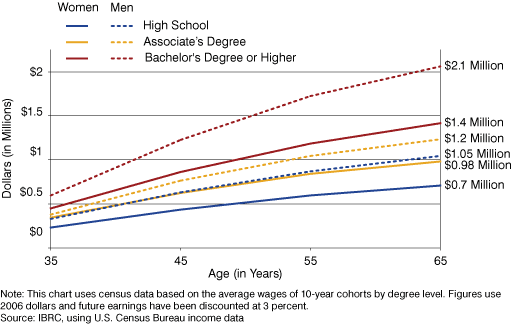
The story points us to this study from Indiana University with more detail on the gender gap, including this chart showing that women must obtain associate's degrees to match the salary levels of men with high school degrees:  

I can't see how this information in any way squares with the notion that women are pulling ahead of men


Wednesday, 10 October 2012

If you're entitled, you probably don't deserve it.

What does it mean to be entitled to something?  It used to mean you earned it, and are owed it, and it would be unfair not to give it to you.  Now it means you are demanding something that you have not earned, are not owed, and cannot in fairness be given.  I view this rhetorical shift as a subtle but very destructive development for spending programs that are tied to revenue sources, e.g., social security in America.  Roosevelt famously insisted on tying the benefit to the tax that funded it:
“We put those payroll contributions there so as to give the contributors a legal, moral, and political right to collect their pensions and their unemployment benefits,” he reportedly responded. “With those taxes in there, no damn politician can ever scrap my social security program.”
But if it becomes rhetorically acceptable to use entitlement to mean the opposite of entitlement, this creates a license for the damn politicians to scrap these programs after all.  This is so even if, like social security, such programs are not actually in fiscal straits.  Rhetoric matters, maybe far too much, in politics.  It is all too easy to convince people that entitlements are not deserved, therefore anything called an entitlement can and should be eliminated.  Worse, so long as you use another term to describe other benefits doled out by government, you get a pass from this scrutiny and judgment.  "Tax incentives" is a ready candidate to fil that rhetorical space, as we have seen in this campaign.  

Elites call for higher taxes in France, stamp feet when their wish is actually granted

Its fascinating to me that elites will only accept high marginal tax rates for purposes of destruction, namely, war.  When it comes to building something, a marginal 75% tax rate on top incomes is seen as outrageous and out of the question-no sane person could support it.  Tax resistance is really anti-social in that way.

Friday, 5 October 2012

Evidence: it's ok to tax millionaires

Richard Murphy points to this story that argues, contrary to conventional wisdom, millionaires do not necessarily flee high tax jurisdictions in search of tax havens:

From the article:

This newspaper's review of tax return data for 2010, the most recent year for which data is available, found no link between the state income tax rate and the number of people who reported adjusted gross income of at least $1 million.
Consider:
  • The states with the most and fewest rich people per capita are Connecticut and West Virginia, respectively. In Connecticut, one of 190 taxpayers earns at least $1 million in adjusted gross income. In West Virginia, just one out of every 1,400 filers make that much. Yet both states tax rich people about the same.
  • Our neighbors: Nevada is income-tax free; Oregon has one of the nation's highest income taxes on the rich; and Arizona is about average. Yet all three have a below-average number of rich people per capita.
  • In the Midwest: Illinois and Ohio charge about the same income-tax rates and have similar populations. Yet Illinois has 233 millionaires per 100,000 taxpayers, while Ohio has 107 per 100,000 taxpayers.
  • In the Northeast: Massachusetts has more than double the millionaires per capita than neighboring New Hampshire, which is income-tax free.

Murphy concludes from this report that "It's fairly easy to move in the US. But people don't."  He therefore suggests we lay the mobility myth to rest since it would be comparatively much more difficult to move across national borders.  If people don't do it when it's easy, what will make them do it when it's hard?

I think and hope this is generally true--that people have cultural/social ties to places that prevent purely fiscal decision-making, so we don't need to coddle the rich out of fear of a Randian exodus, but can ask them to contribute more to the societies in which they live.  But the high profile cases we see in the news suggest that when it comes to the super-rich things might not be so clear.  Maybe they stay put but nothing stops them from engaging in the standard game playing that puts money out of sight to governments while doing so.  It could even be worse for society if they physically hang around but play all kinds of games rather than paying their taxes; in that case, it might be preferable if they pull a Saverin.


Students in their Classrooms

A fascinating set of photos from Visual News

England, Washington, Year 7 (first day), Registration

England, Erith, Year 10, English

England, Wolsingham, Year 12, English

Argentina, Buenos Aires, Grade 4, Natural Science

Saudi Arabia, Dammam, Kindergarden, Activities

Yemen, Manakha, Primary Year 2, Science Revision

Qatar, Grade 8, English

Bahrain, Saar, Grade 11, Islamic

Brazil, Cipó, Series 4, Geography

Brazil, Belo Horizonte, Series 6, Mathematics

Peru, Cusco, Primary Grade 4, Mathematics

USA, Oklahoma, Avant, Grade 4 & 5 Social Sciences

USA, St Louis, Grade 4 & 5, Geography

USA, Oklahoma, Barnsdall, Grade 4 & 5, Science

Nigeria, Kano, Ooron Dutse, Senior Islamic Secondary Level 2, Social Studies

Tokyo, Japan, Grade 5, Classical Japanese

Argentina, Buenos Aires, San Fernando, Year 3 Secondary

Taiwan, Ruei Fang Township, Kindergarten, Art

Cuba, Havana, Playa, Year 9, national television screening of film 'Can Gamba' (about Cuban participation in Angolan Revolution)

Germany, Düsseldorf, Year 7, English