Thursday, 9 August 2012

The Cayman Islands: A Modern Morton's Fork?

The Cayman Islands has come to stand as the epitome of the offshore tax haven.  Yet, until just the other day, the Cayman Islands had proposed a first of its kind income tax (dubbed a "community enhancement fee") of 10% on the income of expats.  Unsurprisingly, expats were less than pleased about this, even going so far as to claim that the mere discussion of the possibility of an income tax could kill the Cayman Islands as the preferred tax haven destination in the Caribbean.  Also unsurprisingly, the Caymans reversed course, introducing a new proposed tourist tax to replace the expat tax.

So what is going on?  The Cayman Islands has one of the highest GDP per-capita in the world, and thus presumably should have no problem raising the relatively small amounts of money at issue.  The problem is that the tax base of the Caymans is fleeting.  Expats (and capital for that matter) came to the Caymans precisely for their zero income tax rate, and presumably will leave just as quickly without it (in the words of one Cayman expat - "no tax or we leave").

Attracting financial business and the people who support it through tax competition is what made the Caymans wealthy from a GDP per-capita standpoint.  That it also is what makes it trapped from a revenue standpoint: raise taxes and lose this tax base (and business) or don't raise taxes and never fund any new public goods.  In a recent article I identify and analyze this phenomenon in depth (subsequent work by economists has also begun to do so).  In the article, I refer to this as a modern Morton's Fork, providing small tax haven type countries with a choice, of sorts, between two equally unappealing options.  In the article, this was a matter of theory.  But, lo and behold, it appears to have become real life.

From a US tax policy standpoint, this should be particularly troubling.  The United States needs tax havens such as the Cayman Islands to stop engaging in tax competition to collect the billions, or even trillions, of lost tax revenue.  The Cayman Islands, at least as evidenced by recent events, can't.  So the world appears stuck.

Perhaps it is time to start thinking differently about tax competition.  Instead of ignoring the Morton's Fork plaguing the Cayman Islands and continue insisting it just stop being a tax haven, the United States could adopt policies to make it easier for the Cayman Islands to do so.  For example, if US tax law made it easier for capital to invest in the Cayman Islands, there would be less pressure on the Caymans to rely on tax competition.  In turn, it would become easier for the Cayman Islands to impose some income taxes, share information, or otherwise cooperate with the United States on tax matters, the benefits of which should vastly outweigh any costs.  I discuss some specific proposals in detail in the article, but the basic premise remains.  While this may seem counter-intuitive at first, recent events only further support the idea that counter-intuitive may be precisely what the international tax system needs at this time.  Absent some fundamental change, my guess is we will only continue to see skirmishes such as the one over the failed Cayman "community enhancement fee" increase over time.

Tax Transparency, California style

California is considering a new bill that would have the FTB "publish a list of the 1,500 largest corporate taxpayers per taxable year, including each taxpayer's tax liability and income apportionment information..."  The 1,500 are "as measured by gross receipts, less returns and allowances, that filed a Form 10-K with the federal Securities and Exchange Commission for that taxable year."  Industry reps consider this a privacy violation for corporate taxpayers.  Maybe, but maybe not.  This involves public companies that have disclosure requirements because they are publicly traded, and it involves information they already disclose to the SEC, only with extraneous (non-California) information removed.  It's not at all clear to me why public companies need privacy rights when it comes to taxes paid.  Why are taxes paid and basic measures of how they are calculated so different than all the other financial information these companies already have to disclose in the interest of illuminating their public shareholders about their financial health?

There is no real difference, but tax disclosure presents a very real social/cultural problem for public companies that are paying very low rates of tax--which apparently includes most or all public companies.  The real worry therefore is not a loss of privacy at all but the legitimate worry that sunshine will lead to bad press as data emerges regarding how public companies arrange their tax affairs.

The latest action on the bill, AB 2439, was a second read plus a third reading ordered in the state Senate.  From the Aug. 8 Senate Floor analysis, we get this:
Existing state and federal laws generally prohibit unlawful disclosure or inspection of any income tax return information. ... the FTB may publish statistical data related to taxpayer information so long as nothing specific to a single taxpayer is disclosed.  Notwithstanding these provisions, the Legislature directed FTB to publish a list of the top 500 tax delinquencies over $100,000... 
ARGUMENTS IN SUPPORT: According to the author's office, this bill will ask for the FTB to post one specific data point on its website which corporations already have: corporation taxes paid to California. It simply disaggregates the amount already reported in their SEC 10-K form to be California-specific.  This simple data is urgently needed for several reasons.  First, California recently made significant changes in its corporation tax system, adopting "elective single sales factor apportionment." This new system means that corporations have a choice of how to apportion multi-state income to California. The FTB has estimated that this choice will cost the state nearly $1 billion annually, beginning in tax year 2011. With this bill, we will be able to accurately determine the distribution of benefits and costs from this drastic change.  
ARGUMENTS IN OPPOSITION: The opposition expresses concerns that this bill will result in misleading information that provides no context for a taxpayer's disposition and will provide no objective evaluation of the single sales factor. For many multi-state corporations, their finality tax liability may not be resolved for years after their return is actually filed so the information in this bill may not be accurate. Furthermore, the opposition states that breeching [sic] taxpayer confidentiality is punitive to the individual taxpayer but will not provide further information to the state to determine whether specific tax policies made sense. 
Regarding the "arguments for," I don't know that the legislature's ability to "accurately determine" things requires the data to be publicly disclosed.  The legislature could as easily simply require public companies doing business in California to include the information on their confidential tax returns, which are typically available to state legislatures to review in the aggregate for policy purposes.  Someone needs to make an argument about why public disclosure is necessary.  There are plenty of available arguments, one need only review the CBCR and PWYP campaigns (or you can read my chapter which examines these arguments).

Regarding the "arguments in opposition," I am not sure why the information is misleading unless companies are reporting false or misleading data to the SEC; if that is the case, we have bigger problems.  No, it is not that the data is misleading.  On the contrary, it is more likely that the data is likely going to be painfully and inconveniently accurate.   True, returns are subject to contestation by the FTB.  I would submit that in the name of the rule of law, the process and outcome of agency contestation ought also to be public information  (it is not, unless the matter ends up in court).  But that is no reason why the original claim is somehow misleading, unless intentionally so by the author.  It is the company's stated position at the time it is made.

Interesting typo alert: it is "breaching" not "breeching" that belongs in that last sentence, but the visual of corporate confidentiality as a baby trying to emerge wrong-way around is quite fascinating.  Still, they've made the right point--the case has not (yet) been made for public disclosure.


Hello, and Thanks for the Invite

I want to thank Allison for inviting me to contribute some thoughts to this blog.  I definitely agree with her on one thing - we do not always agree on matters tax and society, but I too always enjoy reading her perspective on things and almost always learn something new.

I look forward to the opportunity to post on some issues I am working on and thinking about, and hope you find them interesting, if not thought provoking.

Welcome to Adam Rosenzweig

I'd like to welcome Adam Rosenzweig, Wash. U. Professor of Law, as a new contributor to the Tax, Society & Culture blog.  We don't always agree on everything tax, society, or culture, but I always enjoy his perspective and look forward to his participation here.

Friday, 3 August 2012

Signs you are the 1%: credible fear of thronging marauders.

I am going to apologize in advance for bringing zombies into this discussion.  But first, this:
“The rich are always afraid. I saw robbers in a bad year once rush into the gate of the great house and the slaves and the concubines and even the Old Mistress herself ran hither and thither and each had a treasure that she thrust into some secret place already planned."
That is from Pearl Buck's The Good Earth (1931).  Now comes this story from NY Magazine:
..."It's incredible, right?" shouts Jeff Greene over the roar of the two-seater dune buggy's motor. "It's 55 acres!" Still in his whites from this morning's tennis match, he's giving a personal tour of his Sag Harbor estate, barreling at 30 miles per hour through the vast forest of scrubby pines and soft moss of its gated grounds. ... Greene made his fortune in real estate, and he’s never been shy about showing it off. “Having money is great,” he says. “It’s fun. The more the better.” ...  “I wish we could spend more time here,” he says. “Honestly, we have so many great homes.
He cuts the engine, and for a moment the only sound is the waves lapping peacefully against the shore. Greene gazes across the bay at the multi-million-dollar houses peeking from behind the trees. I assume he’s quietly contemplating acquiring even more of the shoreline, but then he says something surprising. “If somebody wanted to go after a rich person,” he observes, “they have got their pick of the litter out here.” 
 It’s not a stretch to say many residents of Park Avenue harbor vivid fears of a populist revolt like the one seen in The Dark Knight Rises, in which they cower miserably under their sideboards while ragged hordes plunder the silver.
“This is my fear, and it’s a real, legitimate fear,” Greene says, revving up the engine. “You have this huge, huge class of people who are impoverished. If we keep doing what we’re doing, we will build a class of poor people that will take over this country, and the country will not look like what it does today. It will be a different economy, rights, all that stuff will be different.” 
...He and Mei-Sze plan on rebuilding as soon as they are done with their renovation in Palm Beach. He's not sure what he wants it to look like, but one thing is likely: The new property will have gates. "You're in Palm Beach, you're in the Hamptons, you think you're so secure," Greene says. "Do you really think if you had 50,000 angry people coming across the river, you think you're safe?"
This speaks volumes about what it means to be free.  Fear, even if irrational, is driving the superrich to wall themselves off from society, fearful of a day of reckoning that must eventually destroy their careful efforts to hoard.  Can anyone really be free in a society which allows the haves to amass such wealth that the resulting disparity creates a credible safety threat from the have-nots?

Now for the zombies.

In the final scenes of the second season of the Walking Dead, the camera pans out to show the survivors huddled around a fire, thinking about what they are going to do to protect themselves from the coming zombie onslaught.  A dim but unmistakable picture emerges that the group is not too far from what looks to be an enormous and well protected prison complex.  One leaves the season with the question of whether barricading the group behind a big enough wall will ensure their survival.  Can they survive behind the wall, and for how long?  How will they feed themselves?  What kind of life can they hope to rebuild there?  The alternative is finding a way to live out in the open without being detected as prey by the vast and apparently growing population of zombies (an alternative suggested by the extremely disturbing and creepy entourage that rescues another of the survivors that had been separated from the group).

We may look back and wonder what on earth sustained the zombie craze that has currently infected all levels of social discourse today, even among academics (besides the sheer silliness of the whole venture).  Perhaps the growing sense of unease about what happens in a world defined by absolute social stratification drives some of the allure. 


Wednesday, 1 August 2012

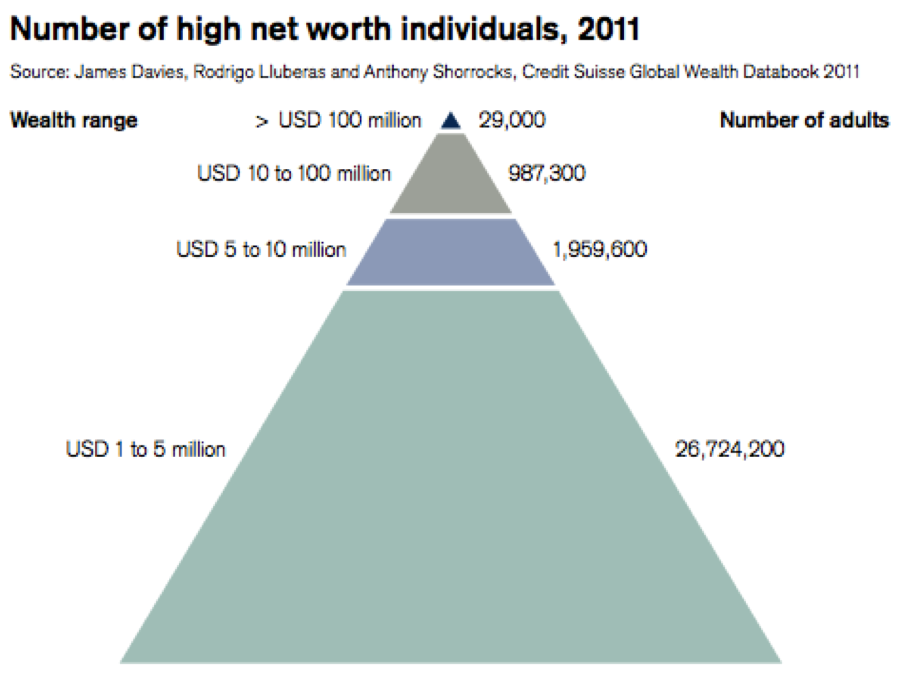
Wealth disparity pyramid

I wish this diagram would draw the rest of the picture, i.e., the enormous block holding up the rest of the pyramid, but this is a powerful visual in any event:


From TJN via Richard Murphy.